Digitizing the Editorial Workflow for Maharashtra's State Marathi Encyclopedia
How a state government encyclopedia board replaced phone calls and email threads with a single accountable system for recruiting, vetting, and managing a statewide network of editorial contributors.
Delivered through the Scriptiqo Delivery System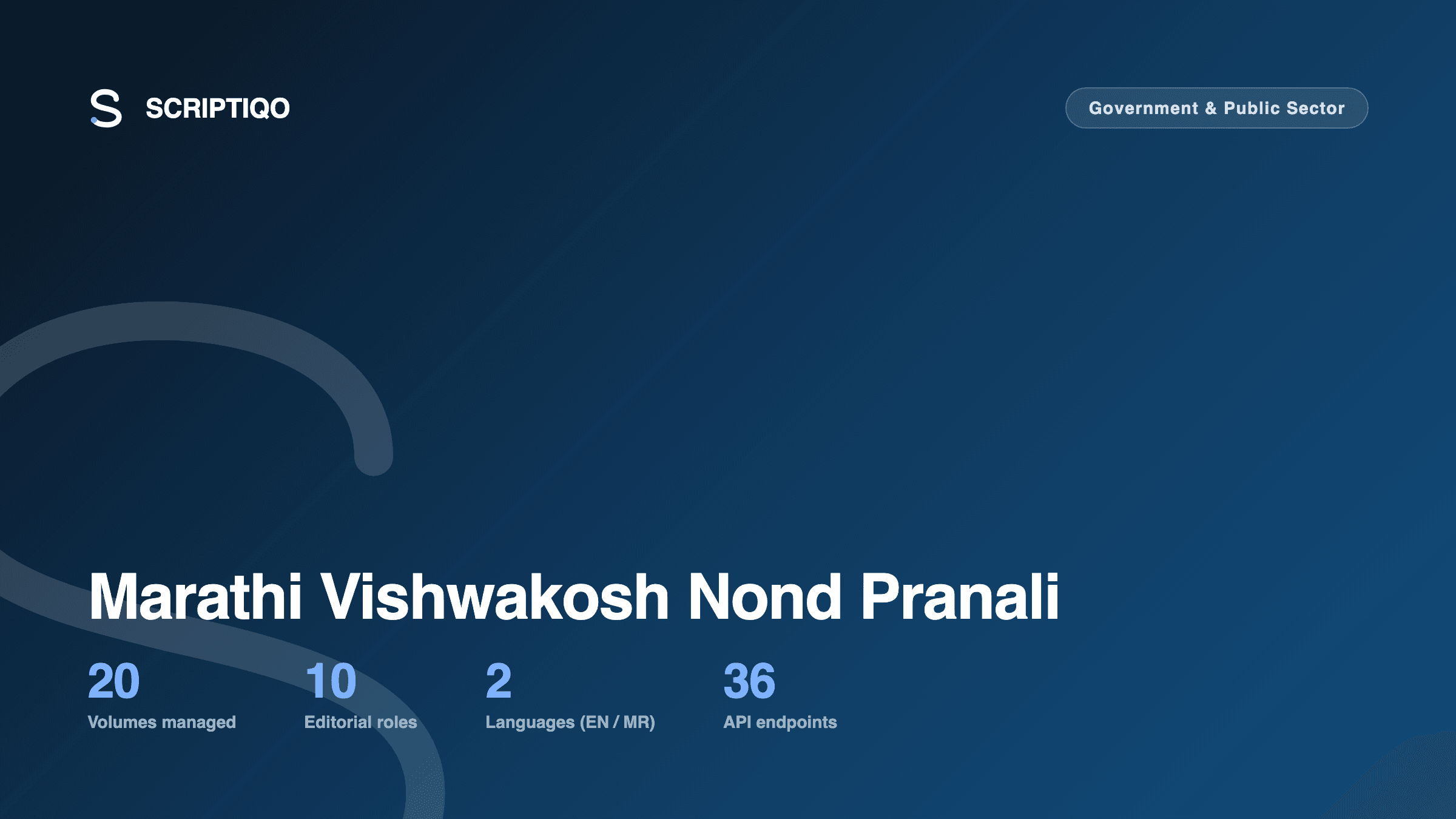
Every volume of the Marathi Vishwakosh — the state's Marathi-language encyclopedia, built in the tradition of Encyclopedia Britannica — passes through the hands of dozens of people before it reaches a reader: authors who draft entries, subject experts who verify them, translators, illustrators, proofreaders, section editors, and a chief editor who signs off on every word. Multiply that by hundreds of topics running at once, across every district in the state, and you get a coordination problem most organizations never have to solve.
The Maharashtra State Marathi Vishwakosh Nirmiti Mandal was running that process by hand — phone calls to confirm who had a topic, email threads to track which draft was the latest, physical document checks for every contributor who joined. It worked, in the way manual processes always work: slowly, with things falling through the cracks, and with no real record of who had touched what.
The turning point
The Mandal wasn't just looking for a website. They needed something closer to an operating system for the entire editorial process — one that could onboard and vet contributors to government standards, route each topic through exactly the right sequence of specialists, keep every draft version accountable to the person who wrote it, and hold up to the kind of security scrutiny a public institution is rightly held to.
That last point mattered more than most software projects ever have to consider. Midway through, an independent security audit (VAPT) flagged a gap in how the platform would eventually need to handle file uploads at scale. Rather than treat that as a footnote, we treated it as a requirement: nothing gets stored until it's been scanned, and if the scanner is ever unavailable, the upload is rejected rather than quietly let through.
What we built
We designed Marathi Vishwakosh Nond Pranali as three connected applications: a public-facing portal where contributors register and do their work, an internal admin panel for the Mandal's own team, and the API and workflow engine tying both together.
A front door that matches the mission
The public site introduces the program the way it deserves — a clear invitation to authors, translators, artists, subject experts, editors, and proofreaders to become part of a genuinely significant cultural project, with each discipline explained in its own terms rather than buried in a generic sign-up form.
An editorial workflow that runs itself
The heart of the system is a workflow engine where every topic carries its own sequence of roles — because a technical entry and a literary one don't need the same reviewers. As a topic moves from draft through review, revision, and approval, every submission is saved as its own version, tied permanently to the person and role that produced it. A coordinator or chief editor can see at a glance exactly where every piece of work sits — submitted, in progress, sent back for revision, or approved — without a single phone call.
Vetting that meets government standards
Registration walks each contributor through education, experience, and work-sample verification, followed by a structured interview pipeline, before anyone is granted access to real assignments. It's thorough by design — this is a state institution's editorial record, and the platform treats it that way.
Security built for a public institution
Beyond the fail-closed malware scanning, we layered in file-content verification that checks what a file actually is rather than trusting its extension, rate limiting and CAPTCHA on public-facing forms, and session controls that keep a single account from being active in two places at once. None of this is visible to a contributor submitting a draft — which is exactly the point.
The whole system also runs bilingually, end to end. Not just the encyclopedia content, but every screen, button, and status update — a contributor or administrator can work entirely in Marathi or entirely in English, without ever hitting a page that wasn't built for them.
What used to require a phone call to find out "who has this topic right now" is now a single glance at a dashboard.
The outcome
The Mandal now runs its entire editorial operation — recruitment, vetting, work assignment, multi-stage review, and publishing — through one accountable system, with a full audit trail behind every decision and a security posture that's already stood up to independent testing. Work that used to depend on someone remembering to make a phone call now happens automatically, visibly, and safely.
It's the kind of project that doesn't show up as a flashy demo — it shows up as an institution that finally trusts its own process. That's the outcome we aim for on every engagement: not just software that works on day one, but a system an organization can keep running on for years.
The Challenge
A statewide network of authors, translators, and editors was being coordinated by phone and email — with no reliable record of who had the latest draft of any entry, and no way to vet contributors to government standards at scale.
Our Solution
A single platform covering compliant contributor onboarding, a configurable multi-role editorial workflow with full version history, and security hardening — including fail-closed malware scanning — validated by an independent penetration test.
Technologies Used
Results & Impact
Client
Maharashtra State Marathi Vishwakosh Nirmiti Mandal